
Ceremonial or culinary matcha for lattes?
High-quality matcha is not wasted in a latte: milk makes it milder, but the colour and taste of the powder stay noticeable in the glass. Cheaper culinary matcha makes sense where heat or strong ingredients cover the taste anyway, such as in baking.
What do "ceremonial" and "culinary" actually mean?
Neither term is an official category. Japan has no government grading for matcha. The labelling guideline of the Japan Tea Central Association defines what may be called matcha, but it sets no quality grades.
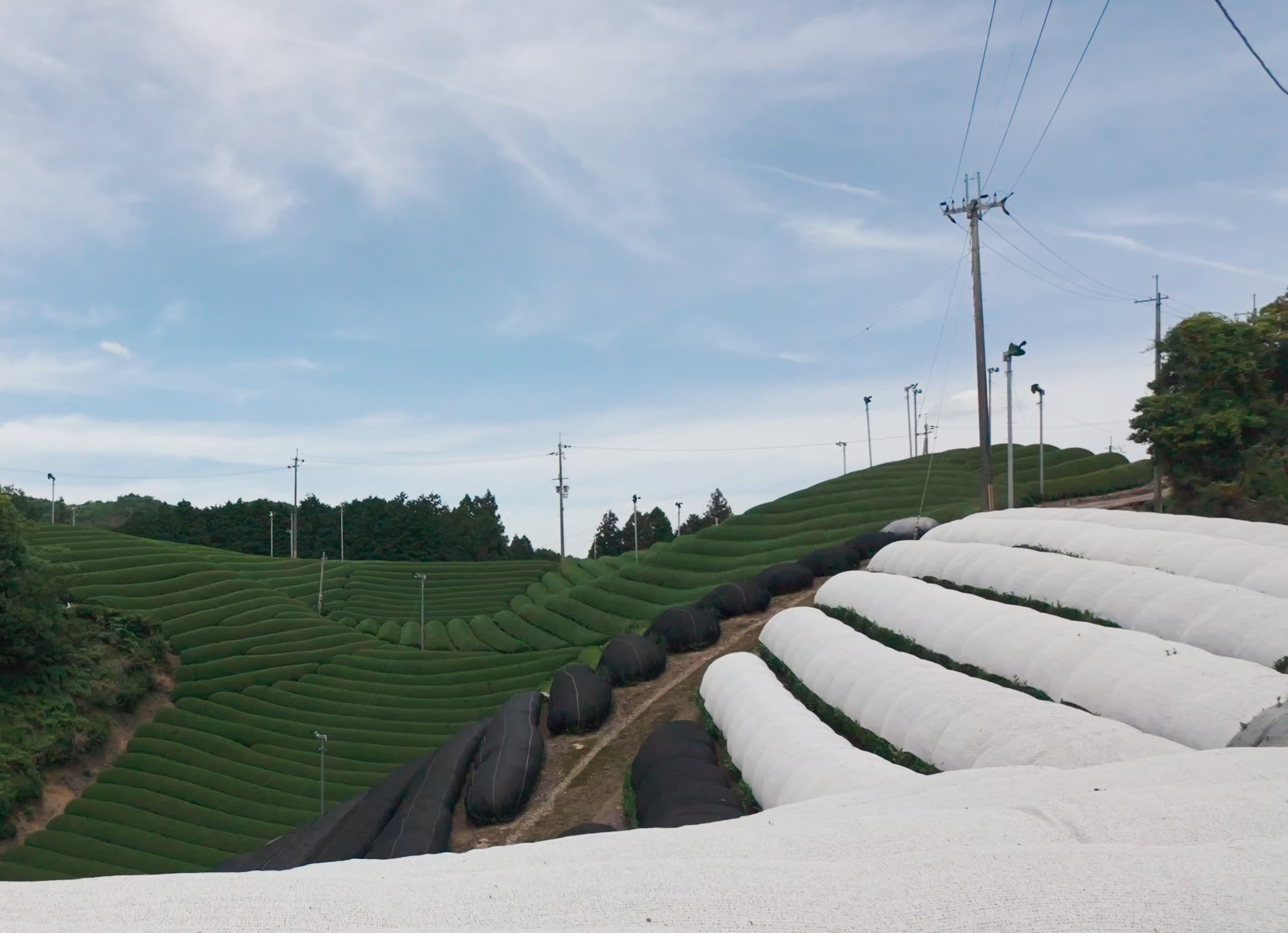
In practice, the terms usually mean this: ceremonial matcha comes from the first spring harvest, from young, shaded leaves. Culinary matcha usually comes from later harvests in summer or autumn. The leaves are older, so the matcha tastes stronger and more bitter and looks less green.
What the label should stand for is explained in What does ceremonial grade mean?
Can you measure the difference?
Yes. A Japanese study compared 25 green tea powders sold in the US, priced from 4.30 to 160 US dollars per 100g. The expensive matchas contained more chlorophyll and more free amino acids such as theanine. Theanine is the amino acid that shapes the umami taste.
In the cheaper powders, a larger share of the chlorophyll had already broken down into pheophytin, an olive-brown pigment. That is why cheap matcha often looks olive instead of bright green. Where these differences come from is explained in First spring harvest vs. later harvests.
What does milk do to matcha?
First, it dilutes. In our standard recipe, 2g of matcha in 40ml of water meets 80 to 120ml of milk. So the matcha base makes up only a quarter to a third of the drink.
Milk also makes matcha taste milder. One reason: milk proteins bind catechins, the compounds that make tea astringent and bitter. Lab studies have shown this binding for whey and casein proteins from cow's milk.
There is less research on plant-based milks. One small lab test found a similar effect for oat and almond drinks as for cow's milk.
What milk cannot do is change the colour of the powder or add umami that isn't there. An olive matcha stays olive in the glass.
Is ceremonial matcha wasted in a latte?
No. In a latte, matcha has to hold its own against two to three times its volume in milk. A matcha with plenty of umami and little bitterness tastes clearly through.
A bitter matcha stays bitter with milk. Many people make up for it with more powder or with syrup. Then the latte mostly tastes sweet, and the tea flavour moves into the background.
Then there is the look. In an iced latte, the green layer sits on top of the milk, so colour is the first thing you see. The foam shows quality too: good matcha whisks into a fine, dense foam, while basic matcha barely foams.
To be fair: with a lot of syrup or fruit purée, the difference gets smaller. If that is how you drink your latte, a cheaper matcha often does the job.
| Use | High-quality matcha | Cheaper matcha |
|---|---|---|
| Pure with water | Ideal | Usually too bitter |
| Matcha latte, hot or iced | Good, colour and umami stay noticeable | Possible, often more bitter and olive |
| Latte with lots of syrup or purée | Good | The difference gets smaller |
| Baking | Possible, heat takes colour and aroma | Sensible, cheaper choice |
| Smoothie with strong ingredients | Possible | Usually fine |
When is culinary matcha the better choice?
For baking. Heat breaks chlorophyll down into olive-brown compounds, much like with cooked vegetables. The bright green and delicate aroma of a high-quality matcha are largely lost in the oven anyway.
For cakes or cookies, a cheaper matcha is therefore a sensible choice. The same goes for smoothies with strong ingredients like banana or berries. There, paying more hardly pays off.
What does the difference cost per latte?
Less than many people think. Taking our organic matcha as an example: 60g cost CHF 49.90 and make 30 lattes at 2g. That is about CHF 1.66 of matcha per latte.
In cafés the gap is even smaller. Basic matcha costs about CHF 0.45 per drink there, ours from CHF 0.67 (net). That is a difference of about 22 Rappen on a matcha latte that usually sells for around CHF 7.50 on Swiss menus.
How do you make a matcha latte?
- Put 2g of matcha into a bowl.
- Add 40ml of water at no more than 80°C.
- Moisten the bamboo whisk (chasen) briefly in warm water. Whisk the matcha for 10 to 15 seconds in a zigzag until a fine, dense foam forms.
- Iced: ice and 80 to 120ml of (oat) milk in the glass, matcha on top.
- Hot: matcha into the cup first, then the foamed milk.
The 2g and 40ml base stays the same whatever the glass size. Less water is better than more: you can't make a cappuccino out of an americano. Syrup or purée goes into the glass first. More detail is in our preparation guide.
If your latte still tastes bitter, water temperature or quantity are the usual suspects. The most common causes are in Why does my matcha taste bitter?
Which matcha do we use?
Our range has one matcha quality, for drinking pure and for lattes. Our organic matcha comes from the first spring harvest in Uji and is ground on granite mills. For baking, we honestly recommend a cheaper matcha.
FAQ
Is ceremonial matcha wasted in a latte?
No. Milk makes matcha milder, but the colour and taste of the powder stay noticeable in the glass. A good matcha still tastes clearly through in a latte.
Can I use culinary matcha for a latte?
Yes. It usually tastes more bitter and looks more olive. With syrup or fruit purée, the difference is less noticeable.
Which matcha is best for baking?
A cheaper culinary matcha. The heat of the oven breaks down much of the colour and delicate aroma anyway.
Is there an official definition of ceremonial grade?
No. Japan has no government grading for matcha. Information on harvest and origin tells you more.
Which milk works best in a matcha latte?
Any milk works. For our signature latte we use 120ml of oat milk with 2g of matcha in 40ml of water.
- Kodama, T.: 抹茶に関する地域ブランドの情報デザイン (Ryutsu Keizai University), cites the Japan Tea Central Association green tea labelling standard (2019 edition)
- Horie et al. (2018), Comparison of the chemical components of powdered green tea sold in the US, JARQ 52(2):143
- Kanakis et al. (2011), Milk beta-lactoglobulin complexes with tea polyphenols, Food Chemistry
- World Tea News: Does milk impact tea's health benefits? (milk proteins binding tea polyphenols, citing Kanakis 2011 and Hasni 2011 on caseins)
- Rheology Lab: Astringency of tea and the impact of plant-based milk (small in-house test with oat and almond drinks)
- Atlas of Science: why processed vegetables are not as green as raw, heat turns chlorophyll into olive-brown pheophytins (Delpino-Rius et al. 2018)