
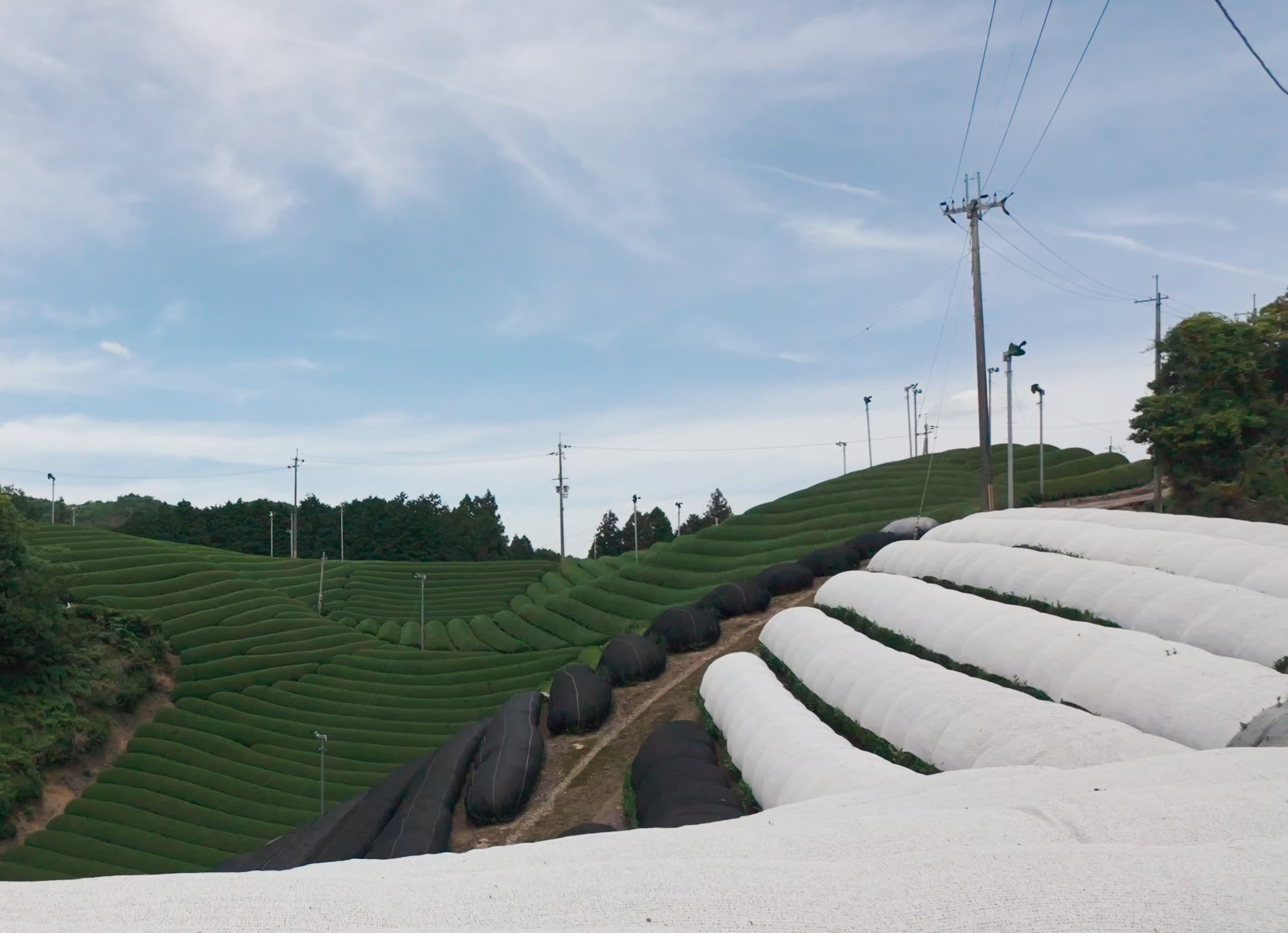
First spring harvest vs. later harvests: what changes in matcha?
Matcha from the first spring harvest (ichibancha) comes from young, shaded shoots with more theanine and fewer catechins, so it is brighter green and tastes smoother. Later summer and autumn harvests give older leaves that have had more sun: they taste more astringent and cost much less.
When is matcha harvested?
The tea plant puts out new shoots several times a year, and each flush gives one harvest. For Uji, the Japanese Ministry of Agriculture lists these harvest times:
- First spring harvest (ichibancha): late April to late May.
- Second harvest: late June to early July.
- Third harvest: mid July to late August.
Some regions, Kyoto among them, add an autumn harvest, which becomes so-called autumn tencha. Tencha: the shaded, steamed and dried tea leaves that matcha is ground from.
What changes between harvests?
Mainly the age of the leaves and how much sun they have had. Almost everything else follows from that.
Theanine is an amino acid that shapes the umami taste. The tea plant makes it mainly in its roots and stores it there over winter. In spring it moves into the new shoots.
Over time and with more sun, the balance shifts. In a study that followed tea leaves through the year, spring leaves contained almost twice as much theanine as summer leaves. Catechin content, in turn, was about a third higher in summer.
Catechins taste bitter and astringent. A high share of amino acids makes green tea rounder. A Japanese tea researcher described this as early as 1970: the first harvest contains more amino acids than the second and third.
What role does shading play?
A big one. In shade, leaves build more chlorophyll and more theanine, and fewer catechins. A 2022 study, for example, grew tea plants under 85 and 95 percent shade for about three weeks and found exactly this pattern.
Later harvests are often shaded for a shorter time. The now withdrawn origin standard of the Nishio matcha region required at least 25 days of shade for the first harvest and at least 12 days for the second.
Autumn tencha often grows with no shade at all. Since 2020, unshaded autumn tencha no longer counts as raw material for matcha under the Japan Tea Central Association's labelling guideline.
| Feature | First spring harvest | Later harvests |
|---|---|---|
| Timing in Uji | Late April to late May | Late June to autumn |
| Leaves | Young, tender shoots | Older, larger leaves |
| Shading | Several weeks | Shorter or none |
| Theanine | Higher | Lower |
| Catechins | Lower | Higher |
| Colour | Bright green | Duller, often yellowish |
| Taste | Smooth, little bitterness | More astringent, more bitter |
| Typical use | Straight and in lattes | Baking, food industry |
| Price | Much higher | Much lower |
How do colour and taste differ?
Matcha from the first spring harvest is a strong green and tastes smooth and naturally a little sweet. Bitterness stays in the background.
Matcha from later harvests is usually duller or more yellowish. It tastes more astringent because the older leaves contain more catechins.
Japanese producers split their use accordingly: matcha for drinking mostly comes from the first harvest. Matcha for food processing tends to come from the second harvest and from autumn harvests.
Why does first harvest matcha cost more?
Because it takes more work. The fields are covered for weeks, and in Uji the first harvest shoots are traditionally picked by hand.
Kyoto prefecture's statistics show the gap clearly. In 2025, a kilo of tencha (excluding the autumn harvest) was worth about 14,500 yen on average, a kilo of autumn tencha about 2,350 yen. That is roughly one sixth.
First harvest tencha fetched an average of 17,124 yen per kilo in 2025, more than twice the previous year. These are prices for the raw leaf before milling. Why matcha has become so much more expensive lately is covered in Why matcha got more expensive.
Is later harvest matcha bad?
No, it simply suits other uses. In baking and desserts, the stronger astringency is less noticeable next to sugar and fat, and the lower price is a real advantage there.
It only becomes unfair when later harvests are sold as “ceremonial” without stating the harvest. What the term does and doesn't mean is in What does ceremonial grade really mean? Whether a latte needs first harvest matcha is covered in Ceremonial or culinary for lattes?
How can you tell which harvest a matcha comes from?
- Pack: Reputable sellers state the harvest, often with the year. It is not a legal requirement.
- Colour: A bright green points to the first harvest, a dull or yellowish green to later ones.
- Taste: Tasted straight, later harvest matcha is noticeably more astringent.
- Price: If the price per gram is very low, it is worth asking about the harvest.
Which harvest is matcha⁷ from?
The first spring harvest. The fields are shaded for about 4 weeks, and the leaves are ground on granite stone mills. We buy the matcha directly from a producer family in Uji, and it is certified organic.
More on its origin is on About your matcha. To try it, there is also a 30g tin.
FAQ
What does ichibancha mean?
Ichibancha is the Japanese term for the first harvest of the year. In Uji it is picked from late April to late May.
Is first flush the same as the first spring harvest?
Yes. First flush is the English term for the year's first harvest, ichibancha in Japanese.
Is second harvest matcha worse?
It is more astringent and usually less green, because the leaves are older and contain more catechins. For baking and desserts it works well and costs less.
Why is autumn harvest matcha so cheap?
Autumn tencha often grows without shade and mostly goes into food processing. In Kyoto, a kilo was worth about one sixth of other tencha on average in 2025.
Does the harvest have to be on the pack?
No, the harvest is not a mandatory label item. If it is missing, ask the seller.
- MAFF (Japanese Ministry of Agriculture): 宇治茶 (Uji tea), harvest seasons and shaded cultivation
- Lin, F. et al. (2021): Tonoplast-Localized Theanine Transporter CsCAT2 May Mediate Theanine Storage in the Root of Tea Plants. Frontiers in Plant Science 12
- Gong, A.-D. et al. (2020), BMC Plant Biology 20, 294: catechins, caffeine and theanine in tea leaves across the seasons
- Nakagawa, M. (1970): Constituents in Tea Leaf and Their Contribution to the Taste of Green Tea Liquor. JARQ 5(3)
- Chen, X. et al. (2022): Effect of Shading on the Morphological, Physiological, and Biochemical Characteristics as Well as the Transcriptome of Matcha Green Tea. Int. J. Mol. Sci. 23(22), 14169
- Kodama, T.: 抹茶に関する地域ブランドの情報デザイン (Ryutsu Keizai University): Nishio shading standard, first flush for drinking matcha, labelling standard
- Kyoto Prefectural Agriculture, Forestry and Fisheries Technology Center: Autumn tencha and the revised green tea labelling standard (2020)
- Kyoto Prefecture: 令和7年度 京都府産茶の生産・流通状況等に関する資料, Part II (production value and volume of tencha and autumn tencha, average first flush prices by tea type, 2025)
- Zhang, L. et al. (2020): Association between chemistry and taste of tea: A review. Trends in Food Science and Technology 101, 139 to 149