
What does “ceremonial grade” matcha actually mean?
“Ceremonial grade” is not an official standard but a Western marketing term: neither Japan nor ISO defines quality grades for matcha. Whether a matcha lives up to the label shows in checkable details on harvest and origin, and in its colour and foam.
Is there an official definition of “ceremonial grade”?
No. No authority or trade body decides when a matcha may be called “ceremonial”. Every seller uses the term as they see fit.
Japan has no official “ceremonial” category either. Japanese tea researchers note that there are no official criteria in Japan for grading powdered green tea by quality.
What is actually regulated in Japan?
What is regulated is what may be called matcha. How good it is, nobody regulates.
The labelling guideline of the Japan Tea Central Association describes matcha as finely ground tencha. Tencha: the shaded, steamed and dried tea leaves that matcha is ground from. According to the guideline, the tea fields are shaded for about 2 to 3 weeks before harvest. Grinding is done on a stone mill or on a machine that works in a comparable way.
Since 2020, autumn tencha grown without shade no longer counts as raw material for matcha under this guideline. According to Japanese tea researchers, basic tea powder is simply sold as powdered green tea in Japan, not as matcha.
Internationally, ISO published a technical report in 2022 (ISO/TR 21380). It describes matcha as tea from shaded leaves that are dried without rolling after steaming, then finely ground. It does not define quality grades such as “ceremonial” or “culinary” either.
So what does “ceremonial” tell you?
At best, it is a recommendation: this matcha is good enough to drink straight with water. At worst, it is a label with nothing behind it.
In Japan, matcha is described more by how it is prepared: whether it suits thin tea (usucha) or also thick tea (koicha). Koicha is made with much more powder and less water, so the highest quality matcha is used for it.
A lab analysis by Japanese researchers shows how wide the gap behind the same label can be. They tested 25 matcha products bought in the US in 2014. The most expensive samples had more chlorophyll and more than twice as much theanine as the cheapest ones. Theanine is an amino acid that shapes the umami taste. Yet one expensive product labelled “ceremonial” scored below other matcha in the same price range.
What should “ceremonial” mean at a minimum?
If a seller uses the term, these points should be met and disclosed:
- First spring harvest (ichibancha): In Uji it is picked from late April to late May. Young leaves contain more amino acids and fewer catechins, which taste bitter and astringent.
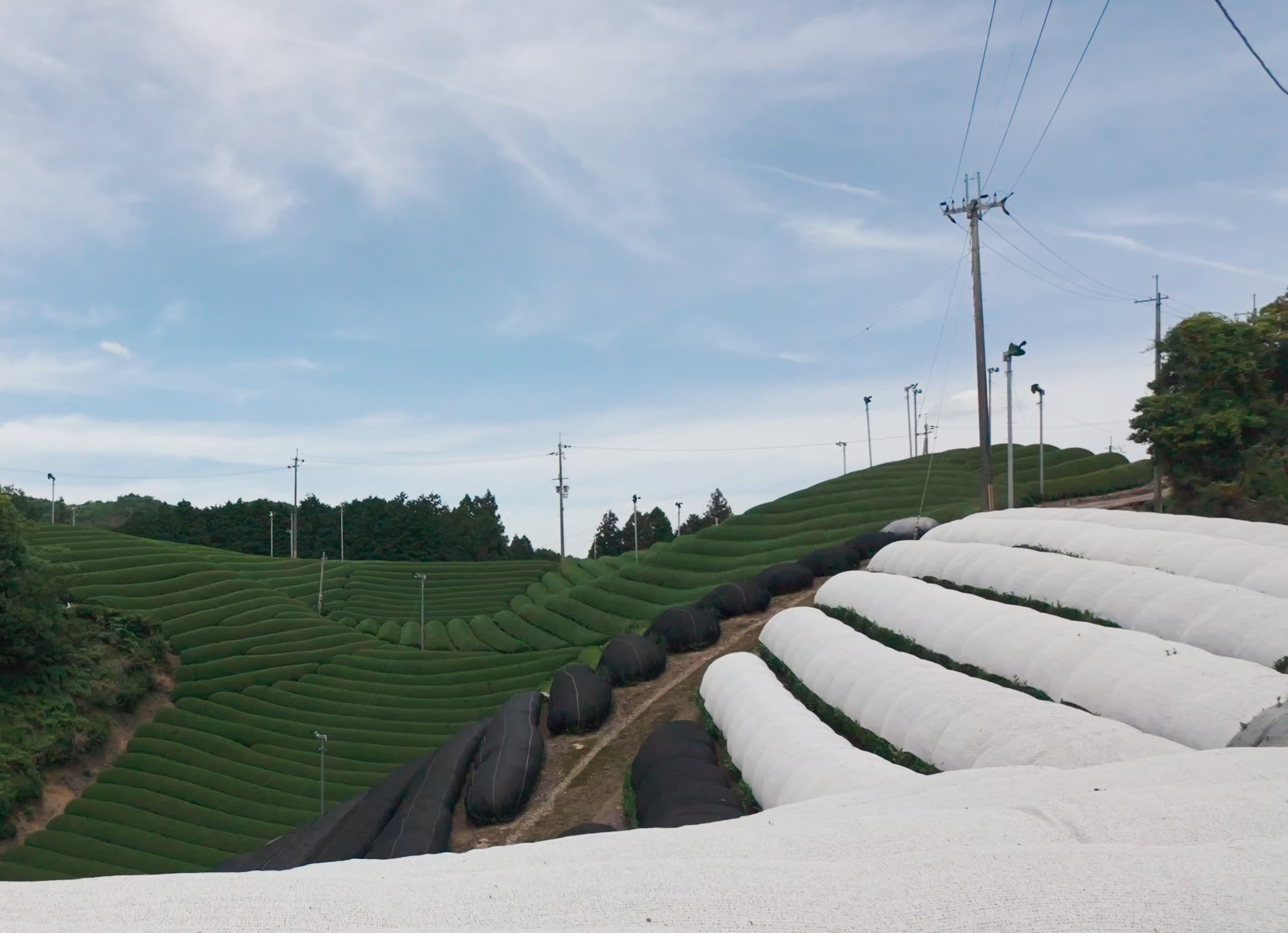
- Shading: Several weeks before harvest. Less light raises chlorophyll and theanine and lowers catechins.
- Stone mill: Slow grinding makes the powder very fine and keeps it from heating up.
- Colour: A strong, bright green. Olive or yellowish tones point to later harvests or old matcha.
- Origin: A region and a producer, not just “Japan”.
| Term | Regulated? | What it tells you |
|---|---|---|
| Ceremonial grade | No | Only as much as the seller discloses |
| Culinary grade | No | Usually later harvests, meant for baking and mixing |
| Matcha (Japan) | Industry guideline | Shaded tencha, finely ground |
| First spring harvest | Seller's claim | Young leaves with more amino acids, less astringent |
| Origin (e.g. Uji) | Seller's claim | A region, not automatically quality |
| Certified organic | Yes, by law | Controlled organic farming, certification body code on the pack (e.g. CH-BIO-006); says nothing about harvest or taste |
How can you check a matcha yourself?
You don't need a lab. The key clues are on the pack and in the matcha bowl (chawan).
- Read the pack: Does it name the harvest and the region? Is there a best-before date? If not, “ceremonial” is just a word.
- Check the colour: Spread a little powder on white paper and look at it in daylight.
- Whisk it: Put 2g matcha and 40ml water at no more than 80°C in the bowl. Whisk for 10 to 15 seconds in a zigzag with a bamboo whisk (chasen). Good matcha forms a fine, dense foam. Weak matcha barely foams.
- Taste it straight: Before any milk goes in. Good matcha tastes smooth and naturally a little sweet, with bitterness in the background.
We explain how to read each sign in more detail in How to tell good matcha.
Is “culinary grade” bad matcha?
Not necessarily. “Culinary” isn't defined either. It usually means matcha from later harvests, which tastes more astringent and is less green. For baking and desserts that is often a sensible choice, and it costs considerably less.
For matcha straight or as a latte, a matcha that tastes good without milk is worth it. We explain why in Ceremonial or culinary for lattes? What changes between harvests is covered in First spring harvest vs. later harvests.
How we handle it at matcha⁷
Our matcha carries the “ceremonial” label too. To make it mean something, we state the facts behind it: it is certified organic and comes from the first spring harvest. The fields are shaded for about 4 weeks, and the leaves are ground on granite stone mills. We buy it directly from a producer family in Uji.
More on harvest and origin is on our matcha quality page. The matcha itself is our organic matcha 60g.
FAQ
Is ceremonial grade an official quality standard?
No. Neither Japan nor ISO defines quality grades for matcha. Each seller uses the term as they see fit.
How can I tell if a ceremonial matcha is good?
Start with checkable facts on the pack, such as harvest and region. Then look at colour and foam: a bright green and a fine, dense foam are good signs.
Is ceremonial grade always from the first harvest?
Not necessarily, because the term is unregulated. Reputable sellers state the harvest on the pack or on their website.
Is expensive matcha automatically ceremonial quality?
No. In a Japanese lab analysis, one expensive matcha labelled “ceremonial” scored below other products in the same price range. Price is a hint, not proof.
Can I use culinary matcha for baking?
Yes. For baking and desserts, matcha from later harvests usually works well and costs less.
- ISO/TR 21380:2022 Matcha tea: Definition and characteristics
- Kodama, T.: 抹茶に関する地域ブランドの情報デザイン (Ryutsu Keizai University), cites the Japan Tea Central Association green tea labelling standard (2019 edition)
- Kyoto Prefectural Agriculture, Forestry and Fisheries Technology Center: Autumn tencha and the revised green tea labelling standard (in force since 1 April 2020)
- Horie, H. et al. (2018): Comparison of the Chemical Components of Powdered Green Tea Sold in the US. JARQ 52(2), 143 to 147
- MAFF (Japanese Ministry of Agriculture): Uji tea, history and harvest seasons
- Chen, X. et al. (2022): Effect of Shading on the Morphological, Physiological, and Biochemical Characteristics as Well as the Transcriptome of Matcha Green Tea. Int. J. Mol. Sci. 23(22), 14169
- Gong, A.-D. et al. (2020), BMC Plant Biology 20, 294: catechins, caffeine and theanine in tea leaves across the seasons
- Zhang, L. et al. (2020): Association between chemistry and taste of tea: A review. Trends in Food Science and Technology 101, 139 to 149
- Wikipedia: Matcha (usucha and koicha, stone milling)
- Bioaktuell / FiBL: Kennzeichnung nach Bio-Verordnung (Code der Zertifizierungsstelle, z. B. CH-BIO-006)