
How is matcha made? From tea field to stone mill
Matcha is made from tea leaves that are shaded for about three to four weeks before harvest, then steamed, dried flat without rolling and stripped of stems and veins. These leaves are called tencha, and a granite stone mill grinds only about 40g of matcha from them per hour.
What is the difference between tencha and matcha?
Matcha is a powder made from one specific raw tea: tencha. That is the name for the shaded, steamed and dried tea leaves that matcha is ground from.
The plant is the same as for sencha, Japan's everyday green tea, or for black tea: Camellia sinensis. What makes the difference is how the tea is grown and processed. The table gives the overview, and below we explain each step.
| Step | What happens | Why |
|---|---|---|
| Shading | Fields are covered about 3 to 4 weeks before harvest | More theanine and chlorophyll, less bitterness |
| Harvest | First spring harvest, in Uji late April to late May | Young leaves, greener and less bitter |
| Steaming | Briefly in hot steam | Stops oxidation, the leaf stays green |
| Drying | Unrolled in a long oven, to below 5 percent water | Keeps well and stays flat for grinding |
| De-stemming | Cutting, removing stems and veins | Gives tencha, only the leaf flesh remains |
| Grinding | Granite mill, around 40g per hour | Very fine, even powder |
| Packing | Airtight and protected from light | Slows oxidation of the powder |
Why are the tea bushes shaded?
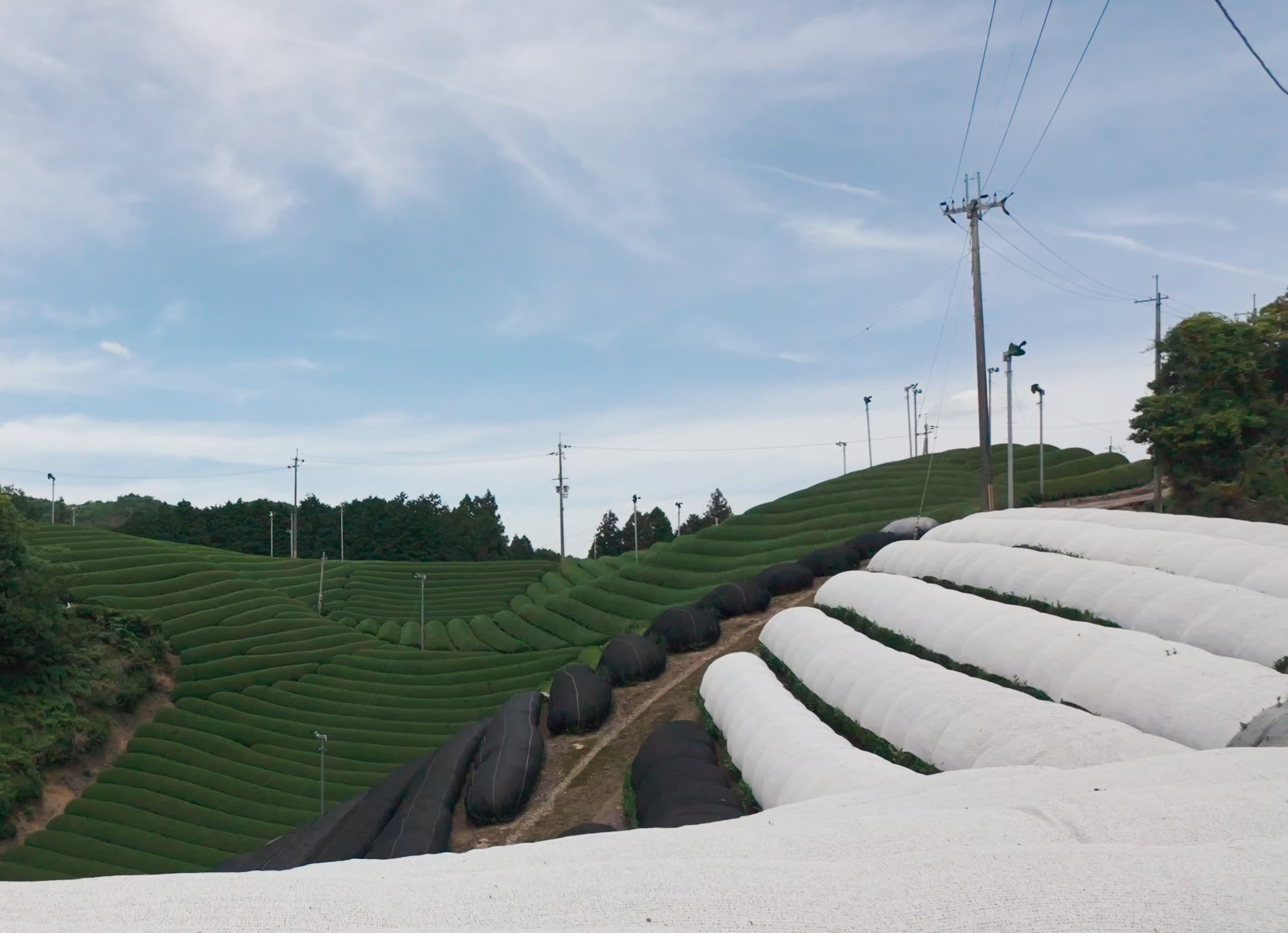
A few weeks before harvest, the tea fields are covered, traditionally with reed mats and straw, today also with cloth. A two-stage cover is widely used in Uji: it first blocks about 80 percent of the sunlight, and about 98 percent after 8 to 10 days. Around 20 days or longer is common. Our matcha is shaded for about 4 weeks.
The reason is plant chemistry. In sunlight, the tea plant converts part of its theanine into catechins. Theanine is an amino acid that shapes the umami taste. Catechins make tea bitter and astringent.
In the shade, more theanine stays in the leaf and the plant builds more chlorophyll. The result is dark green leaves with more umami and less bitterness.
When is the tea for matcha harvested?
High-quality matcha comes from the first spring harvest (ichibancha). In Uji it is picked from late April to late May, for tencha often by hand. The second harvest follows from late June to early July.
Leaves from later harvests in summer or autumn are older. Matcha made from them usually tastes more bitter and looks less green. What exactly changes between harvests is explained in First spring harvest vs. later harvests.
What happens right after picking?
The fresh leaves are steamed briefly. This stops oxidation: the leaf stays green instead of darkening like black tea. So matcha is not fermented.
Then air blows the leaves up several times. This cools them down and removes the water on their surface.
Why is tencha not rolled?
For sencha, the leaves are rolled after steaming. Tencha stays flat because it will be ground anyway.
Instead, the leaves dry in an oven that can be about 10 metres long. Radiant heat and warm air dry them on several conveyor belts until less than 5 percent water remains in the leaf.
Why are stems and veins removed?
After drying, the leaves are cut into small pieces. Air flow and sieves then separate stems and veins from the leaf flesh. These parts are too tough to grind finely between stones.
What remains is tencha: flat pieces of dark green leaf. Only these go into the mill.
How much matcha does a stone mill grind per hour?
Very little. Two granite stones turn slowly against each other and rub the tencha into powder. One mill makes around 40g per hour.
For scale: 40g is enough for 20 servings of 2g. So one serving takes the mill about 3 minutes, and a 60g pouch about an hour and a half.
The upside: the powder comes out very fine and even. A Japanese study measured an average particle size of about 11.5 micrometres for regular matcha, just over a hundredth of a millimetre.
Is machine-milled matcha worse?
Not automatically. Machines grind faster and more evenly. One industrial method for cooking-grade matcha makes around 10kg per hour, about 250 times as much as a stone mill.
For baking or large volumes, that makes sense. In our experience, the quality of the leaves matters more than the mill: late-harvest, bitter leaf will not become good matcha on granite either.
Is every green powder matcha?
There is no binding international definition. A Japanese study compared 25 green tea powders sold in the US, priced from 4.30 to 160 US dollars per 100g. The expensive matchas contained more chlorophyll and more free amino acids such as theanine. Many cheap powders had a different composition but were sold as matcha too.
The researchers therefore call for an international definition. Until there is one, concrete information on the pack helps, such as harvest and origin. What else to look for is in How to spot good matcha.
Why is matcha so sensitive after grinding?
As a fine powder, matcha has a huge surface area. Oxygen and heat therefore act faster than on whole leaves.
A Japanese storage study shows how much temperature matters: sealed matcha kept good quality for 24 weeks at 4°C. At 37°C it was clearly worse after only 3 to 4 weeks.
That is why matcha is packed airtight and protected from light. Every one of our packs carries a best-before date, one year from sealing. Our 60g pouch is resealable. How to store an open pack is explained in How to store matcha after opening.
Where does our matcha come from?
We buy directly from a producer family in Uji that works with the tea farmers and mills the matcha itself. Our organic matcha comes from the first spring harvest and is ground on granite mills. It is so fine that it needs no sifting. As is traditional for matcha, it is a blend of two tea cultivars.
FAQ
How long does it take to grind one serving of matcha?
A granite mill grinds around 40g per hour. A 2g serving therefore takes about 3 minutes.
Is matcha fermented?
No. The leaves are steamed right after harvest, which stops oxidation. That is why matcha stays green.
What is tencha?
Tencha is the shaded, steamed and dried tea leaf with stems and veins removed. Only when it is ground does it become matcha.
Is stone-ground matcha always better than machine-milled matcha?
Not automatically. Leaf quality matters more than the mill. For baking and large volumes, machine-milled matcha is a sensible choice.
How long are tea bushes shaded for matcha?
Around 20 days or longer is common. Our matcha is shaded for about 4 weeks.
- MAFF (Japanese Ministry of Agriculture): Uji tea, shaded cultivation, harvest times, tencha processing
- Kyoto Prefecture: history and production of Uji tea, tencha drying oven and de-stemming (PDF)
- Kyoto Prefectural Tea Research Institute: research history, cultivation (two-stage cover for tencha and gyokuro, about 80 percent shading, about 98 percent after 8 to 10 days) (PDF)
- NARO Institute of Fruit Tree and Tea Science (2018): 被覆茶安定生産マニュアル, manual for shaded tea (tencha shaded about 20 to 30 days; reed screens and straw traditionally, black synthetic cloth today) (PDF)
- Global Japanese Tea Association: how matcha is processed (no rolling, under 5 percent moisture, 40g per hour vs 10kg per hour)
- Kauai Now News (2025): traditional stone mill producing about 40g of matcha per hour
- Kyoto Prefectural Tea Research Institute (1999): grinding methods for summer and autumn tea leaves (stone mill: low capacity, fine and uniform particles) (PDF)
- Haraguchi, Y., Imada, Y., Sawamura, S. (2003): Production and characterization of fine matcha for processed food. Nippon Shokuhin Kagaku Kogaku Kaishi 50(10), 468 to 473 (regular matcha: mean particle diameter 11.5 micrometres)
- Chen et al. (2022), Effect of shading on matcha green tea, International Journal of Molecular Sciences 23(22):14169
- Horie et al. (2018), Comparison of the chemical components of powdered green tea sold in the US, JARQ 52(2):143
- Haraguchi et al. (2002), Effects of storage conditions on quality of matcha, Tea Research Journal 93:1