
Uji and other matcha regions: what does origin tell you?
The largest share of Japan's tencha, the raw material for matcha, comes from Kagoshima (38 percent in 2023), ahead of Kyoto with Uji (23 percent), Shizuoka and Aichi with Nishio. Origin tells you about climate and tradition, but not which harvest a matcha comes from.
Where is matcha produced in Japan?
The raw material for matcha is tencha: the shaded, steamed and dried tea leaves that matcha is ground from. So to see where matcha comes from, you look at tencha production.
In 2023, Japan produced 4,176 tonnes of tencha, according to the national federation of tea producers. Around 90 percent of it came from five prefectures:
- Kagoshima: 1,585 tonnes, 38 percent
- Kyoto: 970 tonnes, 23 percent
- Shizuoka: 505 tonnes, 12 percent
- Aichi: 365 tonnes, 9 percent
- Mie: 314 tonnes, 8 percent
Volumes have been rising for years. In 2025, national output reached 6,278 tonnes. According to the Japanese agriculture ministry, the order at the top has stayed the same: Kagoshima ahead of Kyoto and Shizuoka.
| Region | Prefecture or country | Share of Japan's tencha, 2023 | Known for |
|---|---|---|---|
| Kagoshima | Kagoshima | 38% | largest tencha volume, earliest harvest |
| Uji | Kyoto | 23% | historic origin, shading since the 16th century |
| various | Shizuoka | 12% | largest tea area, mainly sencha |
| Nishio | Aichi | 9% | tea fields almost entirely for tencha |
| various | Mie | 8% | number one for gyokuro (shaded leaf tea) |
| Yame | Fukuoka | within the remaining 10% | shaded leaf tea, protected gyokuro |
| Zhejiang, Guizhou | China | not part of the statistics | over 12,000 tonnes of matcha in 2025 |
| Jeju, Boseong | South Korea | not part of the statistics | growing matcha production |
What makes Uji special?
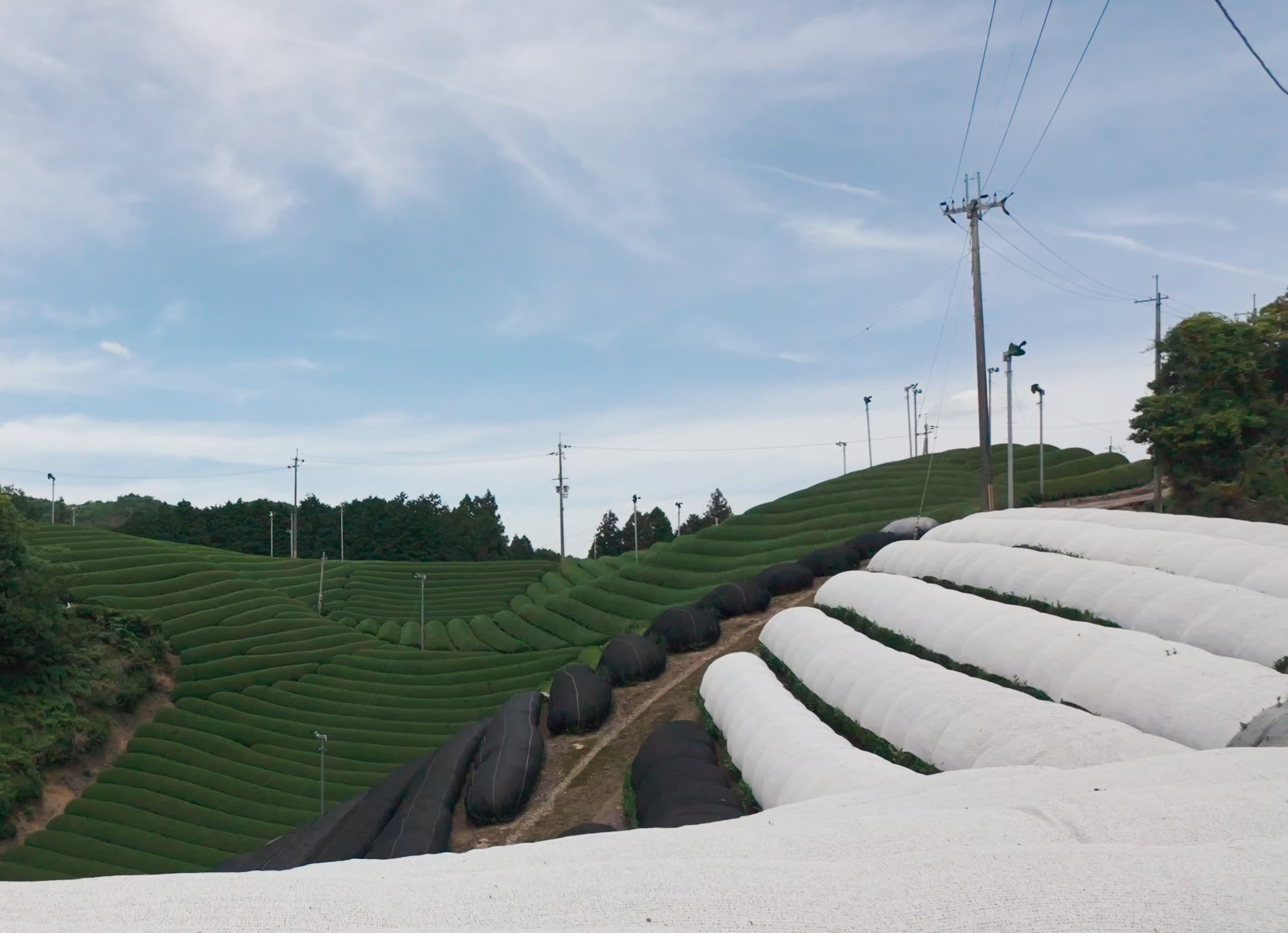
Uji lies south of the city of Kyoto and is the historic home of matcha. According to the agriculture ministry, tea growing there goes back to tea that the monk Eisai brought from China in 1191. In the 16th century, growers there developed the shading of tea fields to produce a deep green, less astringent tea for the tea ceremony.
Today, Kyoto ranks second for tencha behind Kagoshima. Worth knowing: the name Uji stands for the whole tea region, not just the city. In 2024, most of Kyoto Prefecture's tencha was grown in other towns in the region, such as Wazuka and Ujitawara. The city of Uji itself supplied just under 4 percent.
What does "Uji tea" on a pack mean?
The term "Uji tea" (Ujicha) is clearly defined, but broader than many people think. According to the agriculture ministry, it is green tea from Kyoto, Nara, Shiga and Mie prefectures that is processed by businesses in Kyoto using the method developed in Uji.
So an Uji matcha can contain leaves from four prefectures. The collective trademark "Uji Tencha" is stricter. Among other things, it requires fields in Uji and Joyo, at least 30 days of shading and hand-picked leaves from the first spring harvest (ichibancha).
The name is also misused. The Japanese agriculture ministry reports cases of matcha from China being sold as "Uji matcha".
What sets Kagoshima apart?
Kagoshima, in the south of the island of Kyushu, is now Japan's largest tencha producer. In 2024 and 2025, it also overtook Shizuoka in total raw tea volume for the first time since records began.
The warm climate allows a long season. The first harvest of the year starts there as early as late March. Many farms work with large machinery. Kagoshima also grows a wide range of tea cultivars.
What about Nishio in Aichi?
Aichi Prefecture ranks fourth for tencha, with 463 tonnes in 2025. Its best-known growing area is Nishio. According to a 2017 report, over 98 percent of its roughly 200 hectares of tea fields are used for tencha.
In 2017, "Nishio no Matcha" was protected as a geographical indication. In 2020, the producers' association had the protection removed because the strict rules kept costs high. It was the first cancellation of its kind in Japan.
What role do Shizuoka and Fukuoka play?
Shizuoka has the largest tea-growing area in Japan and is best known for sencha. It ranks third for tencha. In 2024, tencha made up only about 2 percent of its tea output. The prefecture is now putting more weight on tencha and organic tea.
Fukuoka, with its Yame growing area, is best known for gyokuro, a shaded leaf tea. The prefecture ranks third for it according to the agriculture ministry. Since 2015, "Yame Dentou Hongyokuro" has been protected as a geographical indication. Matcha is made in Yame too. But in 2023, Fukuoka was not among the five largest tencha prefectures.
Is there good matcha from China or Korea?
Matcha is no longer made only in Japan. According to the China Tea Marketing Association, China produced over 12,000 tonnes of matcha in 2025. The largest volumes come from Zhejiang and Guizhou, especially the city of Tongren. Producers there supply drink chains and the food industry, among others.
The figures from China and Japan cannot be compared directly. The Japanese statistics count tencha, the Chinese ones matcha. And what counts as matcha is not defined the same way everywhere.
Matcha is also made in South Korea, for example on Jeju island and in Boseong in the south of the mainland. We have not found reliable production figures for it.
Origin alone says nothing about quality. There is carefully made matcha from China and Korea, just as there is basic matcha from Japan. What matters most is the harvest and the processing.
What does origin tell you, and what doesn't it?
Origin tells you quite a lot:
- the country, which is mandatory information on packs in Switzerland
- the climate and tradition of a region
- whether a producer is open about its supply chain
It does not tell you:
- which harvest the matcha comes from (first spring harvest or later in the year)
- how long the plants were shaded
- how finely and gently it was ground
- how fresh the matcha is
A matcha from Uji can come from a late harvest, and a matcha from Kagoshima from the first spring harvest. We explain why the harvest matters so much in First spring harvest vs. later harvests. Terms like "ceremonial grade" are not regulated either, see What "ceremonial grade" actually means.
Our matcha comes directly from a producer family in Uji, from the first spring harvest and certified organic. More about its origin is on About your matcha.
FAQ
Does most matcha come from Uji?
No. In 2023, 38 percent of Japan's tencha came from Kagoshima and 23 percent from Kyoto, where Uji is located. Uji is the historic home of matcha, but no longer the largest region.
What does "Uji matcha" mean?
According to the Japanese agriculture ministry, Uji tea is green tea from Kyoto, Nara, Shiga and Mie that is processed by businesses in Kyoto using the Uji method. Stricter rules apply to the collective trademark "Uji Tencha".
Is matcha from Kagoshima worse than matcha from Uji?
Not automatically. Quality depends mainly on harvest and processing, and both regions produce matcha at every quality level.
Is matcha also made in China?
Yes. According to the China Tea Marketing Association, China produced over 12,000 tonnes of matcha in 2025, mainly in Zhejiang and Guizhou. Because definitions differ, the figures cannot be compared directly with Japan's tencha statistics.
Does the origin of matcha have to be on the pack?
In Switzerland, the country of production is mandatory information on food. A region such as Uji or Kagoshima is voluntary.
- MAFF Japan: Tencha production by prefecture, 2023 crop (source: Japan Tea Production Organizations federation; total 4,176t)
- MAFF Japan: Cha wo meguru josei, October 2026 edition (main prefectures and rankings; Kagoshima 1st in tencha, Kyoto 2nd, Shizuoka 3rd; Mie 1st in gyokuro; Fukuoka 3rd in gyokuro; Kagoshima 1st in raw tea 2024 and 2025)
- MAFF Japan: Cha wo meguru josei, full version (cases of Chinese-made matcha sold as Uji matcha)
- Aichi Prefecture: tea review document, 2025 crop (Aichi tencha 463t, 4th nationally; national tencha 6,278t)
- Kyoto Prefecture: tea production survey 2024 (tencha by municipality: Wazuka 52.0%, Ujitawara 14.1%, Uji 3.6%)
- MAFF Japan: Uji tea, traditional foods (definition and history)
- Japan Patent Office: regional collective trademark Uji Tencha, No. 6205526
- MAFF Japan: Kagoshima tea, traditional foods (early harvest from late March, large machinery)
- Business Insider Japan (2017): Nishio matcha GI registration (about 200ha, over 98% tencha)
- Jiji Press (2020): Nishio matcha GI cancelled, first in Japan
- Jiji Press via The Nation Thailand (25.02.2026): Shizuoka aims to reclaim top tea status with matcha focus (tencha about 2% of Shizuoka output in 2024, shift to tencha and organic tea)
- Fukuoka Prefecture: Yame tea (GI registration 2015)
- GI Japan register: Yame Dentou Hongyokuro, No. 5
- Have a Good Holiday (16.10.2025): Yame Matcha EN launch (matcha made in Yame)
- Xinhua via The Borneo Post (28.06.2026): Matcha boom turns Guizhou tea into new growth ingredient (China over 12,000t in 2025, China Tea Marketing Association)
- People's Daily Online via eHangzhou (17.06.2026): China brews global matcha success (Zhejiang 8,851t, Tongren 2,500t in 2025)
- Business Wire (24.09.2025): Clean Jeju Green Tea Cooperative Sumang targets global market with matcha
- MoneyToday (29.07.2026): Korean products with Boseong and Jeju matcha
- Verordnung des EDI betreffend die Information über Lebensmittel (LIV, SR 817.022.16), Art. 3 und Art. 15 (Produktionsland)