
Where to find good matcha in Switzerland: how to spot it in a café
Good matcha in Switzerland is served in cafés that whisk it fresh for every drink instead of preparing it in advance. A good matcha latte is bright green with a fine, stable foam, and it tastes mild with little bitterness.
How do you recognise a good matcha latte?
A look at the glass and one sip before any syrup tell you most of what you need to know. This works the same in Basel as in Zürich, Bern, Lucerne, Lausanne or Lugano.
| Feature | Good sign | Warning sign |
|---|---|---|
| Colour | Bright green | Olive or yellowish |
| Foam | Fine, dense microfoam | Barely any foam or large bubbles |
| Preparation | Whisked fresh for each drink | Pre-mixed in a bottle or jug |
| Taste | Little bitterness, clear umami | Distinctly bitter |
| Texture | Smooth, no lumps | Lumps or sediment |
| Origin | Region and harvest known | No information |
Colour: bright green, not olive
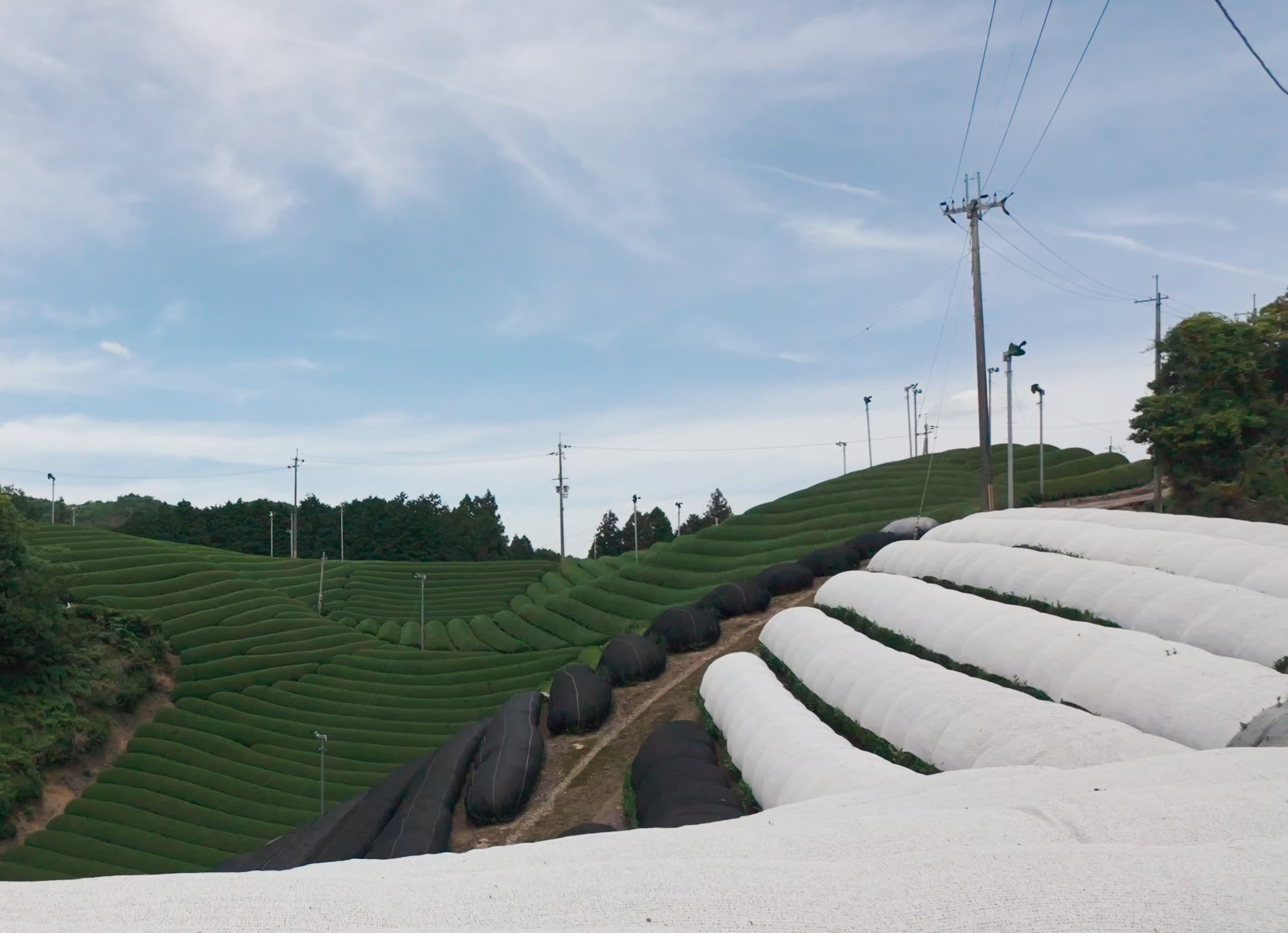
Matcha is ground from tea leaves that are shaded for several weeks before harvest. Shading raises the chlorophyll content, so the leaves turn a deeper green. That is why good matcha is bright green.
If it looks olive or yellowish, it usually comes from a later harvest or has been open for a while. Chlorophyll breaks down with oxygen and heat, and the colour fades with it.
The colour is easiest to judge in an iced latte where the matcha goes in last, on top of the milk and ice.
Foam: fine and stable
Good matcha, freshly whisked, forms a fine, dense microfoam. Lower grade matcha barely foams, or forms large bubbles that collapse quickly.
Whether the café uses a bamboo whisk (chasen) or an electric frother matters less. What counts is that the matcha is whisked fresh.
Taste: mild, with little bitterness
Good matcha tastes smooth and naturally a little sweet, with clear umami. L-theanine plays a part here: it is an amino acid in the tea leaf that shapes the umami taste.
Bitterness comes mainly from catechins. Shading lowers their content in the leaf, while matcha from later harvests often tastes more bitter. A lot of syrup covers this up, so if you can, take the first sip unsweetened.
Freshly whisked or made in advance?
Some cafés mix matcha with water in advance and pour it from a bottle or jug. It saves time, but the quality suffers.
Matcha does not dissolve. The finely ground leaves are only suspended in the water and settle over time. Pre-batched matcha loses its foam and goes stale within hours. Matcha that sat in the fridge with water overnight is no longer fit to serve the next day.
Whisking fresh takes 10 to 15 seconds. If you can see or hear your matcha being whisked, that is a good sign.
What can you ask the barista?
Good cafés are happy to answer these questions. The answers usually tell you more than any label on the menu.
- Is the matcha whisked fresh? The most important question. Fresh means for each drink, or for a few drinks at once, not in advance.
- Where is the matcha from? A specific region in Japan, such as Uji south of Kyoto, says more than "Japanese matcha".
- Which harvest is it from? Matcha from the first spring harvest (ichibancha) is the reference. Summer and autumn harvests usually give a less green, more bitter matcha.
- How much matcha goes into a drink? We work with 2g of matcha to 40ml of water as the base. With much less matcha, the latte turns pale and milky.
- How hot is the water? We use 80°C at most. Hotter water extracts more catechins, and the matcha tastes more bitter.
A label like "ceremonial grade", on the other hand, says little. It is not an official grade in Japan; more on this in What does ceremonial grade mean?.
Is lower grade matcha in a latte a problem?
Lower grade matcha usually comes from a later harvest in summer or autumn and from older leaves. It costs less. In return, it is often more bitter and less green.
For baking it is often fine. In a latte the difference stays visible, mostly in colour and foam. Why good matcha still makes sense with milk is covered in Ceremonial or culinary for lattes?.
How to check matcha powder yourself before you buy it is explained in How to spot good matcha.
Which cafés serve matcha⁷?
Our matcha is served in specialty cafés across Switzerland. These cafés are listed publicly on our partner page (as of October 2026):
- Basel: BRÜ Specialty Coffee, specialty coffee café
- Canton of Lucerne: Four Hundred (MG) Coffee Roastery, 3 locations: the roastery in Hitzkirch and the cafés at Inseli Park and Max Chocolatier in Lucerne
- Lugano: re:fuel by re:form pilates club, café at the re:form pilates studio
- Scuol (GR): La Motta Bergrestaurant, mountain restaurant at the Motta Naluns top station
- Thurgau: nichtnur Fenstercafé, specialty coffee café
Running a café and thinking about adding matcha? Terms and samples are on our page Matcha for cafés.
And if you make matcha at home?
Our standard, also for lattes:
- Put 2g of matcha into a bowl.
- Add 40ml of water at 80°C at most.
- Whisk with a moistened bamboo whisk for 10 to 15 seconds in a zigzag until a fine, dense foam forms.
- Drink it pure, or add 80 to 120ml of (oat) milk for a latte.
The full steps are in our preparation guide. Our certified organic matcha from Uji is available as organic matcha 60g.
FAQ
What colour should a good matcha latte be?
The matcha layer should be bright green. Olive or yellowish tones point to a later harvest or to matcha that has been open for a while.
Is pre-made matcha in a café worse?
Yes. Pre-batched matcha loses its foam and goes stale within hours. Matcha that sat in the fridge with water overnight is no longer fit to serve.
What should I ask a café about its matcha?
The most revealing question is whether the matcha is whisked fresh. After that, origin and harvest help, for example Uji and the first spring harvest.
Why does my matcha latte in a café taste bitter?
Often it comes down to matcha from a later harvest or water that is too hot. Matcha that has been sitting pre-mixed also tastes stale.
Where is matcha⁷ served in Switzerland?
In specialty cafés across Switzerland, including in Basel, Lucerne, Lugano, Scuol and Thurgau. The public list is on our partner page for cafés.
- Chen et al. (2022): Effect of Shading on the Morphological, Physiological, and Biochemical Characteristics as Well as the Transcriptome of Matcha Green Tea, International Journal of Molecular Sciences 23(22), 14169
- Haraguchi et al. (2002), Effects of storage conditions on quality of matcha, Tea Research Journal 93:1
- Kim et al. (2020), storage temperature and matcha quality (colour, catechins), Food Science and Biotechnology 29:1261
- Zhang, L. et al. (2020): Association between chemistry and taste of tea: A review. Trends in Food Science and Technology 101, 139 to 149
- MAFF (Japanese Ministry of Agriculture): おいしいお茶の淹れ方 (water temperature, umami compounds from about 50°C, catechins and caffeine at 80°C and above)
- Choi et al. (2000): Changes in Chemical Compositions of Green Tea under the Different Extraction Conditions, Journal of Life Science 10(2) (catechin extraction rises with water temperature)
- VinePair (Olivia White, 15 January 2026): Do matcha grades mean anything? ("ceremonial grade" was coined outside Japan, no body regulates the term)
- Haraguchi, Imada and Sawamura (2003): Production and characterization of fine matcha for processed food, Journal of the Japanese Society for Food Science and Technology 50(10) (matcha is suspended in water and sediments over time)
- Caffè Atlas: BRÜ Specialty Coffee, Basel (descriptor)
- Four Hundred (MG): official website (specialty coffee roaster, cafés in Luzern)
- Eversports: re:form Pilates Club, Lugano (descriptor)
- MySwitzerland: Bergrestaurant La Motta, Motta Naluns, Scuol (descriptor)